

29/01/2016

03/08/2012
time for fresh wind

* de Nederlandse tekst vind je verderop *
When I - without
any hesitation - closed my eyes for a power nap in a cafe in downtown Tokyo, I realised
that I have gotten well accustomed into Japan. I would never do this in any other city outside Japan. Nor would I go downstairs to buy another coffee, leaving all my
valuables unattended. According
to our standards sleeping is something intimate that belongs to the private
domain. But here in Japan sleeping in public is common practice. Most offices
facilitate by placing coaches and even the university library has rows of soft
comfortable fauteuils, so tempting for a nap especially on hot days. Many do, which I perfectly understand, but I
can’t help feeling a bit uncomfortable when reading in an academic book with a
slightly snoring student next to me.
On the other hand, the Japanese consider talking,
with each other or by telephone as something strictly private. So when in
public you speak very softly, avoid making telephone calls and switch off the
sound. As a result you experience a kind of silence when in public, which is
nice, in particular when in the library. Remarkably though this pleasant stillness is regularly roughly disturbed by an extremely loud sneeze. With the same forceful dedication the Japanese
– at least Japanese men – have the habit to scrape the throat, not once but on and on and on. Fortunately the final climax – that disgusting habit
which is still common practice in China – is inappropriate in Japan, but apparently
the long, noisy prelude is acceptable when in public.
Now summer has really started, I observe
another remarkable difference in the perception of public and private. Balconies and roof terraces remain empty. Used to Mediterranean habits, we put the table
outside, have dinner and enjoy the cool breeze that softly blows from the
mountains. Nobody does, even not in our apartment building where many foreigners
live. Windows, sliding doors, and curtains remain closed. Nobody to be seen.
Nothing to be heard. Apparently the balcony belongs to the public space, so it
will not be used for private affairs. It is
just used for storage and as a work space. Our washing machine for example is
placed right in the middle, handy for washing indeed, but besides it is a real
stand in way.
During these hot summer weeks the Japanese
literally pay a high price for their habit to hide inside their homes. Instead
of using cool breezes to lower temperatures, the airco’s – energy guzzler
number one – are working overtime, albeit to eliminate the heat of the refrigerator
motor in the small kitchen. Applying natural ways to keep summer
life bearable, would save a lot of energy and money. People could easily save
10 per cent on electricity by adjusting the airco to 1 degree higher. From next
week on however we will all be forced to seek alternatives for cooling down. The
electricity company just send us the schedule of planned power outages in
August. We are kindly requested to take
measures during days with a high chance of blackout. Isn’t this the ideal
moment to break with traditions and to turn balcony and roof terraces into
refreshing, green, comfortable indoor-outdoor spaces?

Tijd voor een frisse wind
Toen ik in een café in Tokyo zonder aarzelen mijn
ogen dicht deed voor een dutje, besefte ik dat ik al aardig ingeburgerd ben in
Japan. Ik zou dit namelijk in geen enkele stad buiten Japan doen. Ik zou
trouwens ook nooit al mijn waardevolle spullen gewoon laten liggen en naar
beneden lopen voor nog een koffie. Maar dit terzijde. Voor ons is slapen iets
intiems dat in de privésfeer thuis hoort. Maar in Japan is slapen in het
openbaar heel gewoon. De meeste kantoren hebben speciale banken en in de
universiteitsbibliotheek staan rijen comfortabele, zachte stoelen; heel
verleidelijk voor een dutje, vooral op warme dagen. Ze worden veel gebruikt, wat
ik me goed kan voorstellen, maar een boek lezen met een zacht snurkende student naast me voelt nog steeds een beetje ongemakkelijk.
Praten daarentegen beschouwt men als iets privés.
Dus in het openbaar praat je zachtjes, je voert geen telefoongesprekken en
zelfs het geluid van de mobiel is uit. Hierdoor is het vaak rustig en stil in
het openbaar. Dat is heel prettig, zeker als je in de bibliotheek bent. Het
rare is dat die plezierige stilte soms ruw verstoord wordt door keihard niesen.
Met dezelfde overgave schrapen Japanners, althans de mannen, hun keel; niet één keer, maar twee, drie, vier keer achter elkaar. Gelukkig blijft de climax, die vieze gewoonte
die men China nog heeft, in Japan achterwege, maar de luidruchtige aanloop is blijkbaar
wel geoorloofd in het openbaar.
Nu de zomer echt begonnen is, ontdek ik nog een ander opvallend verschil in openbaar
en privé gedrag. Balkons en dak- terrassen blijven leeg, terwijl wij al lang
onze tafel buiten hebben, ‘s avonds op het balkon eten en genieten van een
lekker koel briesje dat uit de bergen waait. Met buiten temperaturen van meer
dan 30 graden zijn we nog steeds de
enigen, zelfs in ons eigen appartementen complex, waar veel buitenlanders
wonen. Ramen, schuifdeuren en zelfs de gordijnen blijven potdicht. Je hoort of
ziet niemand. Blijkbaar hoort het balkon bij de openbare ruimte. Daarom gebruik
je het niet voor privé zaken, maar puur functioneel. Onze wasmachine staat
bijvoorbeeld midden op het balkon. Heel handig
als je moet wassen, maar verder is het een lastige sta-in-de-weg.
In deze hete zomerweken betalen
Japanners letterlijk een hoge prijs voor hun gewoonte om binnen te blijven. Airco’s,
energievreter nummer 1, maken overuren, alleen al om de warmte van de koelkastmotor
weg te werken die in het kleine keukentje blijft hangen. Meer natuurlijke
manieren om de zomer draaglijk te houden, scheelt veel energie en dus geld. Alleen
al door de airco een graad hoger te zetten, bespaart men al gauw zo’n 10
procent. Tel uit je winst.
De kans is groot dat we
binnenkort gedwongen worden om een alternatief voor de airco te verzinnen. De elektriciteitsmaatschappij stuurde een
brief met een overzicht van de dagen dat de elektriciteit mogelijk afgesloten
wordt. We worden verzocht om alvast voorzorgsmaatregelen
te nemen. Is dit geen ideaal moment met de traditie te breken en balkons en
dakterrassen om te toveren in frisse, groene, comfortabele binnen-buiten ruimtes?
17/07/2012
money matters

* de Nederlandse tekst vind je verderop *
Opening a bank account in
Japan took about 4 hours spread over 2 visits. Several official documents were
required and a number of forms had to be completed. One of the major problems
to tackle was the fact that I have three middle name. Add to that that my last
name isn’t very Japanese. Together, these five names (my first name, my three
middle names, and my last name), when set in Japanese characters, took up far
too much space and didn’t fit in the allocated spaces on the form. Moreover, it
was easy to make mistakes in the characters. So everything had to be checked
and double checked. It is a good thing as several tiny differences in the
characters were discovered and one little stroke more or less can seriously alter
the meaning of the character. After getting all my names right, the bank
officer calmly but decisively went through all the documents. She explained
precisely how I deposit money, withdraw money, save money, transfer money
through the internet, how much money the various transactions cost, and more,
and she did all of this in Japanese. So thanks to my assistant/interpreter, I
am now a client at Japan’s number one bank, the Mitsubishi UFJ Financial Group
(MUFJ).
After all these
formalities and all the seriousness, you can imagine my surprise when after a
week I received by post a happy Disney bank card and bank notebook. Too cute.
What was missing in all of this was Scrooge McDuck as he seems to reflect the
Japanese way of dealing with money so well. The Japanese are not only careful
spenders (quality first); they are also the best savers in the world. On
average, Japanese families save 20 percent of their monthly income. Mortgages
are kept low and repaid within a short amount of time. Credit card debts are
rare: on average $0.70 cents versus a $2.200 in the USA.
As a result, personal
savings are astronomical (on average, a family has around €160.000).
Interestingly, despite the good service and the cute cards that banks offer
their clients, many Japanese still opt to keep their savings in private
money-boxes at home. They tend to distrust banks, which seems to me, at this
point in time, to be common sense given the bank crisis where millions lost
their savings. Currently, the Japanese save more money than ever and widely
neglect the government’s call to do the opposite. The government’s message to
spend more for the sake of the economy doesn’t seem to appeal to them.
Apparently, when it comes to money, the Japanese attitude of safety first takes
precedence over their respect for authority.
Considering all this, it
is not surprising that most things are still paid for in cash. In shops,
debiting purchases or paying with plastic is uncommon. Even regular payments
like one’s rent or one’s electricity bill are often paid for in cash. As such,
the Japanese are quite used to dealing with large numbers of bank notes. And if
you don’t like the idea of your money having passed through so many hands, you
just go to the money cleaning machine, which quickly removes stains and
bacteria from your bank notes.
Despite the thorough
explanations provided to me by the very patient bank officer, I still find
using the payment machine to be a huge challenge. All of instructions are in
Japanese. Fortunately, the bank has a special uniformed service employee whose
main task is to welcome clients and provide assistance if needed. In my case,
he did the entire payment process for me. He pressed all buttons needed, except
my pin code (In his words: “the secret numbers”) where he pointed to where I
needed to press and then discretely turned his back. Without trust, I would have been completely lost.

geldzaken
Het
duurde vier uur om een bankrekening te openen. Er waren allerlei officiële
papieren nodig en een heleboel formulieren moesten worden ingevuld. Bovendien
ontstond er een groot probleem door mijn vier voornamen en mijn familienaam
bleek nogal ingewikkeld voor het Japans. Alles bij elkaar waren de vijf namen
(mijn vier voornamen en de achternaam) veel te lang voor de ruimte op het formulier.
Omdat er gemakkelijk fouten gemaakt worden in het Japanse schrift, moest alles
ook nog eens heel goed nagekeken worden. Dat is op zich prima, want een klein
streepje meer of minder kan een heel andere betekenis geven. Toen eindelijk
alles goed opgeschreven was, nam de medewerkster rustig maar gedecideerd alle
formulieren nog eens met me door. Daarna legde ze heel precies uit hoe ik geld
kan storten, kan opnemen, kan sparen, hoe ik kan
internetbankieren, hoeveel de verschillende transacties kosten en nog veel
meer. En dat alles in het Japans. Gelukkig heb ik een assistente /vertaalster
en dankzij haar ben ik nu klant van de grootste bank in Japan: de Mitsubishi
UFJ Financial Group (MUFJ).
Je kunt je voorstellen hoe verrast ik was toen ik na
zoveel serieusheid, een bankpasje en bankboekje vol vrolijke Disney figuurtjes
thuis gestuurd kreeg. Heel schattig. Maar Dagobert Duck staat er niet op,
terwijl hij toch het boegbeeld zou kunnen zijn van hoe Japanners met geld
omgaan: voorzichtig (kwaliteit staat voorop als men iets koopt), geen schulden
maken en veel sparen. Een gezin spaart gemiddeld 20 procent van het
maandinkomen. Hypotheken zijn laag en worden snel afbetaald. En er zijn
nauwelijks schulden op betaalkaarten: $ 0,70 cent tegen $2.600 in the USA. De
persoonlijke spaartegoeden zijn dan ook astronomisch ( €160.000 per gezin).
Momenteel sparen Japanners meer dan ooit en ze negeren daarmee de oproep van de
regering om het tegenovergestelde te doen. Ze voelen zich niet aangesproken
door de boodschap om de economie te stimuleren door meer te kopen. Als het op
geld aankomt, weegt safety first voor Japanners blijkbaar zwaarder
dan hun gevoel voor autoriteit.
Al is de service van de banken nog zo goed, veel
Japanners bewaren hun spaargeld gewoon thuis in spaarpotten. Zij hebben van
oudsher niet zo'n vertrouwen in banken; een mentaliteit waar ik nu wel begrip
voor kan opbrengen gezien de recente bankcrisis waarbij miljoenen hun spaargeld
kwijt raakten. Het is dus eigenlijk niet zo vreemd dat de meeste aankopen nog
steeds contact betaald worden. Pinautomaten en plastic betaalkaarten worden
nauwelijks gebruikt. Zelfs maandelijkse betalingen als de huur of elektriciteit
worden cash gedaan. Voor Japanners zijn grote pakken bankbiljetten dus
heel gewoon. Mocht je het een vervelend idee vinden dat je geld door veel
andere handen gegaan is, dan biedt de geld-wasmachine uitkomst.Die verwijdert vlekken en je krijgt je biljetten weer fris en gladgestreken terug.
Ondanks de gedegen uitleg van de bankmedewerkster,
vind ik het een enorme klus om met de betaalautomaat de huur te betalen. Alle
instructies zijn in het Japans. Gelukkig heeft de bank een speciale medewerker
in uniform die als taak heeft iedereen vriendelijk te begroeten en te
assisteren indien nodig. Hij heeft de hele betaling persoonlijk voor me in orde
gemaakt. Alle toetsen heeft hij ingedrukt, behalve die van mijn pincode,
de“geheime cijfers” zoals hij ze noemde. Die wees hij aan, daarna draaide hij
zich discreet om en wachtte tot ik klaar was. Zonder vertrouwen was ik hier nergens.
08/07/2012
wild ducks

* de Nederlandse tekst vind je verderop *
In my hometown Maastricht I am used to cycle to work along the river. It
is very pleasant that I can continue this habit in Kyoto where I live
close to the Kamo gama: the wild duck
river. There are two differences
however. The distance to my workplace is larger (3.5 km) and the route is far more adventurous. So it is a double change for the better.
The
Kamo River has its source in the mountains, North of Kyoto . Somewhere near the
centre the river joins with the Takano River which flows
down from the north-eastern direction. Since these mountain rivers have just
a few artificial constructions, the river
area looks natural and rather pristine.
Indeed it is a huge nature area
throughout this big city.
I start my morning ride in the North where
the bumpy narrow path goes along several waterfalls. The water
level is usually relatively low; less
than one meter in most places. But since the rainy season has started, the river is
full and the water clatters downstream. Under the first bridge I balance on a strip of 80 centimetre along a
row of zero yen houses closely watching the
doors in case the resident might come out. Soon after, the path becomes wider, so I can bike more relaxed. The riverbanks are very popular
spots for the outdoor activities like walking, running, fishing or gymnastics.
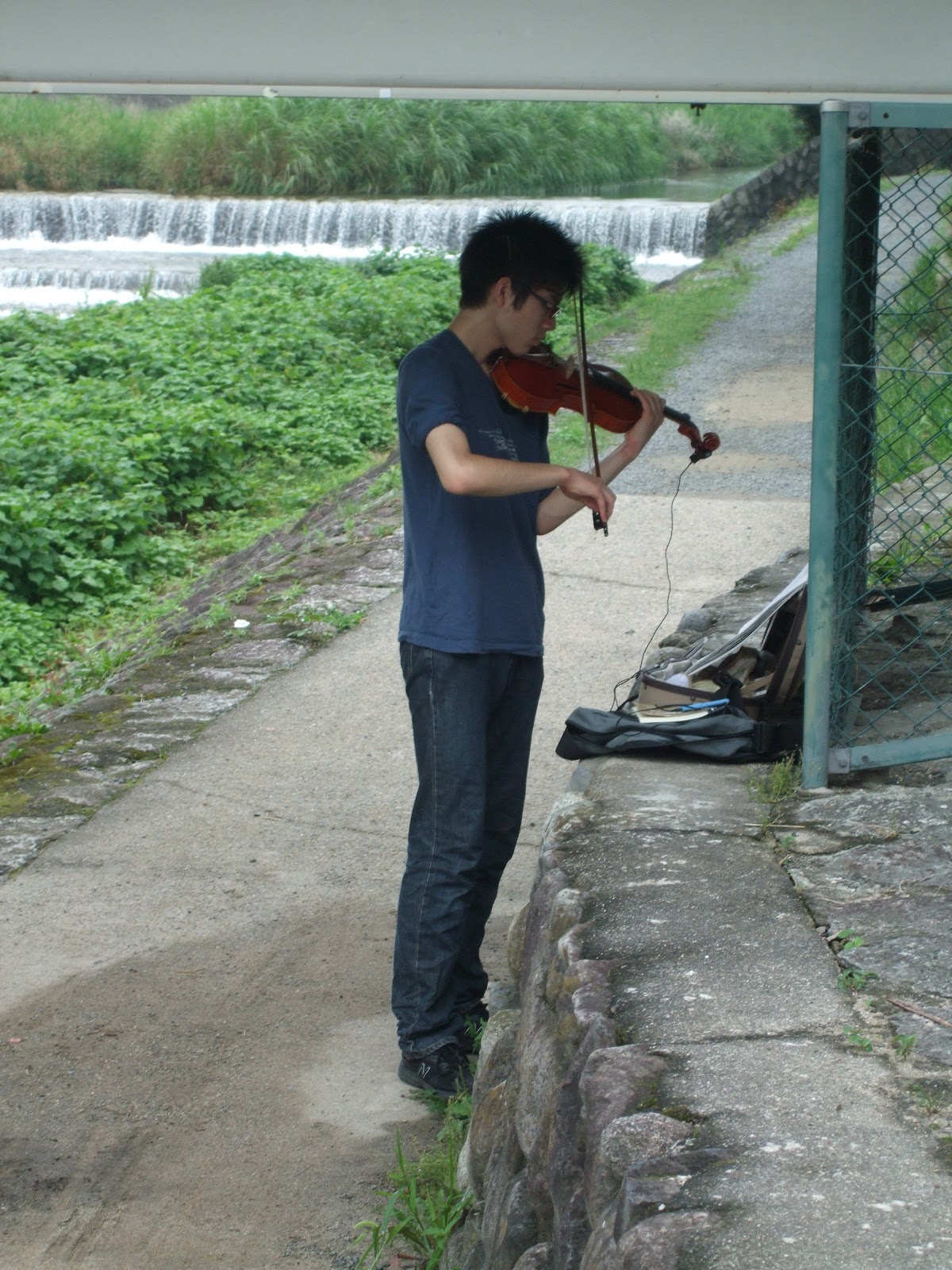
But the Kyoto residents also go to the river to play music, practice choir chants or declaim. For them this beautiful public space is an extension of
their small, thin- walled house. Nobody seems surprised, except a gajin like me (the Japanese word for
foreigner; literal meaning: alien ) who cannot resist to make pictures.
Fortunately, there is no time clock in
the institute where I work.
Please enjoy some ‘wild
duck’ impressions below.
wilde eenden
In mijn woonplaats Maastricht fiets ik altijd langs de rivier
naar mijn werk. Het is fijn dat ik dit in Kyoto kan blijven doen, want ik woon hier dicht bij de Kamo gama: de wilde eend
rivier. Maar er zijn twee belangrijke verschillen. De afstand naar mijn werk is
nu een stuk langer (het is 3,5 kilometer) en de route is avontuurlijker. Het is dubbel zo leuk dus.
De Kamo rivier begint
in de bergen
ten noorden van Kyoto. Bij het centrum van de stad komt
hij samen met de Takano rivier die
vanuit de bergen ten oosten van
de stad naar beneden stroomt . Anders dan bij de Maas zijn
er maar een paar constructies aangebracht in deze berg rivieren. Daardoor ziet het rivierengebied er heel natuurlijk en ongerept
uit. Feitelijk is het een enorm natuurgebied, dwars door deze grote stad heen.
Ik begin mijn ochtendritje
in het noorden over een hobbelig pad langs verschillende watervallen. Het
waterpeil is meestal laag; op de meeste plaatsen minder dan een meter. Maar nu
het regenseizoen is begonnen, is de rivier vol en klettert het water naar
beneden. Onder de eerste brug balanceer ik over een strook van zo’n 80 centimeter
langs een rijtje zero yen huizen. Ik
hou de deurtjes angstvallig in de gaten,
voor het geval een bewoner naar buiten
zou willen. Even later wordt het pad breder en kan ik ontspannen verder
fietsen. De oevers van de rivier
zijn heel populair voor de gebruikelijke outdoor
activiteiten zoals wandelen, hardlopen,
vissen of gymnastiek. Maar de inwoners
van Kyoto gaan ook naar de rivier om muziek te spelen, te zingen of te
declameren. Deze prachtige plek is voor
velen een verlengstuk van hun kleine, gehorige woningen. Niemand
kijkt er vreemd van op, behalve een gajin
als ik ( het Japanse woord voor buitenlander, dat letterlijk alien betekent), die het niet kan laten
foto’s te maken. Gelukkig is er geen tijdklok op het instituut waar ik werk.



02/07/2012
green is cool

* de Nederlandse tekst vind je verderop *
The Japanese are fond on nature and gardening, and so
am I. As I wander around this large city, I am often pleasantly
surprised. I see tiny flower gardens planted in front of houses, elegant trees
peaking out above bamboo fences, and colourful creepers against walls. Even
more astonishing are the many productive plots that you see around this city.
Vegetable gardens and even small rice fields are fairly common. Some are for
private use but, on the outskirts of the city, there are still quite a few
plots for commercial production, and since they tend to be wedged between
houses or even apartment buildings, the pleasure of this rural experience is always unexpected. But the plots are indeed useful. The
proceeds are directly sold to the citizens who are very keen about their food
being fresh. In the morning, the farmer’s wives drive their small trucks through residential areas, their trunks full of
seasonal vegetables freshly harvested just a few kilometres away.
This tradition of small scale agriculture has been
revitalised by the Do you Kyoto campaign to make
Kyoto more
sustainable. People are stimulated to grow vegetable gardens and schools are
given extra facilities if they join the campaign, which they often do. Urban
farming is a great way to improve quality of life and sustainability in the
cities. Should lack of space on the ground be an obstacle, then the top of the
buildings offer plenty of room to expand. In Kyoto, the first attempts at roof
gardens are now taking place but, in Tokyo, the metropolitan authorities started requiring building owners and developers to plant trees on rooftops back
in 2001. The requirement applies to commercial buildings with more than 1,000
sq. meters of floor space and public buildings of more than 250 sq. meters.
This requirement was implemented as a means to mitigate the heat in summer and
reduce air conditioner use. The effects have been measured in a study showing
that roof temperatures have decreased significantly and indoor temperatures
have been lowered by 1 to 3 degrees. Additionally, this measure has lead to new
enterprises such as Tokai no Noen (City Farm) that develops and commercially
exploits roof gardens. Prices for a plot of 3 sq metres are around 200 Euros,
but roof gardens are still very popular. The kind of people willing to pay the
200 euros per 3 square metres varies, as do their motivations to do so. Some
families rent plots so that their kids can experience nature. Some elderly
people rent plots because they want fresh air and some physical exercise. Other
people rent plots because they like to have fresh, reliable food or they want
to connect with fellow gardeners. Also, there are companies who rent plots and
offer them to their employees. Their harvest parties are usually accompanied by
a whole lot of beer. Clearly, the benefits of having a garden are varied.


Groen is cool
Japanners
zijn dol op de natuur en op tuinieren. En ik ook. Als ik door deze grote stad wandel,
ben ik regelmatig aangenaam verrast. Ik zie mini bloementuintjes langs
voorgevels, sierlijke bomen die boven bamboe schuttingen uit steken, en fleurige
klimplanten tegen muren. Nog verrassender zijn de landbouw veldjes die overal
in de stad te vinden zijn. Groentetuinen en zelfs kleine rijst veldjes zijn hier
heel gewoon. Sommige zijn voor privé gebruik maar naarmate je verder in de
buitenwijken komt, zie je steeds meer landbouw akkertjes voor de handel. Omdat
de veldjes helemaal ingeklemd zitten tussen huizen en zelfs appartement
gebouwen, is zo’n dorpse ervaring altijd een onverwacht plezier. Maar de landjes zijn vooral erg nuttig. Ze zorgen voor
verse producten. En dat is iets wat Japanners heel belangrijk vinden. In de ochtend zie je de boerenvrouwen in hun smalle
vrachtwagentjes door de woonbuurten rijden; de laadbak vol met groenten die net
geoogst zijn, een paar kilometer verderop.
Deze traditie van kleinschalige
landbouw is nu onderdeel van de Do You Kyoto campagne voor een duurzame stad. Het
idee is om zoveel mogelijk groenten zelf te verbouwen. Particulieren en scholen
krijgen extra faciliteiten als ze meedoen. Mocht er te weinig ruimte op de
grond zijn, dan bieden de daken genoeg uitbreidingsmogelijkheden. In Kyoto
vinden nu de eerste experimenten met daktuinen plaats, maar de metropool Tokyo
heeft al sinds 2001 voorschriften voor
het beplanten van daken. Het is verplicht voor commerciële gebouwen met een
oppervlakte van meer dan 1000 m² en openbare gebouwen groter dan 250 m².
De maatregel is bedoeld om de hitte in de zomer tegen te gaan en het
gebruik van airco’s te verminderen. En dat is het geval, zo blijkt uit
onderzoek. De temperatuur van het dak gaat
inderdaad behoorlijk omlaag. De binnentemperatuur daalt met 1 tot 3 graden. De
maatregel heeft nieuwe bedrijfjes opgeleverd
zoals stadsboerderij Tokai no Noen, die daktuinen aanlegt en exploiteert. De
huurprijs voor een lapje grond van 3 m² is al gauw zo’n 200 euro per maand, maar
toch zijn de tuintje heel populair. De mensen die dit bedrag neer tellen zijn
heel gevarieerd, net als de redenen om een tuintje te beginnen. Gezinnen huren
een landje om hun kinderen natuur ervaring te laten opdoen. Anderen huren een
landje omdat ze vers, betrouwbaar voedsel willen en contact met andere tuiniers.
Oudere mensen huren een tuintje vanwege de frisse lucht en de lichaamsbeweging.
En sommige bedrijven huren een stuk grond
voor de ontspanning van hun personeel. Zij vieren het binnenhalen van de
oogst meestal met heel veel bier. Een stadstuin heeft kortom ongekend veel voordelen.
24/06/2012
fukushima 2: power to the people?
 | |
| Fukushima prefecture, close to the no-go area |
* De Nederlandse tekst vind je verderop *
A nuclear power free Japan was short-lived. Prime
minister Noda now approved the start up of two OI plant reactors
located close to Kyoto. It will take a few weeks before they are
fully up and running but the government felt that reactors should be
started up to prevent a potential power crunch this summer. And so he
added, “we need it to ensure a sustainable growth”.
I find the
use of the word ‘sustainable’ in this context remarkable given
that the term has long been used to argue against nuclear energy. As
such, it is a solid part of the vocabulary of the anti-nuclear
movement. Its use here is ironic and indicative of the ‘defeat the
enemy with their own weapons’ communication strategy – a strategy
that, in my opinion, has also been extensively used by Dutch
politicians. In fact, the former vice prime minister Verhagen, who,
by the way, seems to have dropped off the planet since the cabinet
fell last April, often spoke of how ‘clean’ nuclear energy is in
his pleas for more nuclear plants in the Netherlands and made
frequent references to the fact that, with nuclear energy, there are
no CO2 emissions.
With the re-opening of these two nuclear plants, the debate on energy has flared up again. Strikingly, most Japanese people are against nuclear energy. In fact, about three quarters of the Japanese population claim to want a nuclear-free Japan and people have shown great self-discipline in reducing their energy consumption. Energy saving has become a kind of national sport. Even electricity bills include hints for energy reduction. Additionally, investments in renewable energy installations are rapidly increasing. For example, sales of solar cells rose 30.7% in 2011. Initiatives to influence political decision-making, however, have had little success thus far. Last week, the Tokyo council rejected a petition signed by 320,000 residents that lobbied for a referendum on nuclear energy in Tokyo and the urgent energy-related requests made by two governors of regions close to the Oi plant have not honoured. They asked Noda to put the plant into operation for only a limited period of time as not all safety procedures have been tested, but Noda and his allies claim that energy supply is a national issue and should thus be decided upon at national level. The governors, the mayors, and the residents oppose that they should call the shots since they have to carry the heavy costs of a nuclear catastrophe.
So, ultimately, this is not about energy; it is about
power and control, and I think it would be better if the debate were
to be framed in this context. As one may rightfully ask whether a
part of modern society as necessary and vital as energy is should be
owned, and thus controlled, by private, market-driven corporations?
The Fukushima catastrophe has painfully demonstrated that as long as
control over energy remains in the hands of a mere few, we risk not
only damage to the environment but to democracy as well.
 | |||
| Nihonmatsu refugee camp |
Fukushima 2
Een kernenergie-vrij Japan was maar een kort leven beschoren. Half juni heeft premier Noda toestemming gegeven om twee reactoren van de Oi centrale, vlak bij de provincie Kyoto, op te starten. Het argument is dat men een energie tekort in de zomer wil voorkomen. Verder zei de premier: “We hebben kernenergie nodig voor een duurzame groei van de economie”.
Het is merkwaardig dat het woord ‘duurzaam’ juist in dit verband gebruikt wordt. De term is nou net een van de belangrijkste argumenten tegen kernenergie en hoort thuis in het vocabulaire van de anti-kernenergie beweging. Deze communicatie truc – ‘versla je vijand met eigen wapens’ – kennen Nederlandse politici ook. Voormalig vice premier Verhagen (ooit nog iets van hem gehoord sinds de val van het kabinet?) blijft maar hameren op het feit dat kernenergie schone energie is. Wat hij feitelijk bedoelt is dat er geen CO2 uitstoot is.
Maar hoe duurzaam kan de groei van de Japanse economie zijn zolang er nog rekeningen open staan? Zoals de rekening van 19 miljard yen (190 miljoen euro) die de burgemeester van Futabato, een klein stadje in het getroffen gebied, onlangs overhandigde aan TEPCO voor de schade door de Fukushima kerncentrale. Maar de totale kosten van de schade zijn astronomische bedragen. Het gaat dan niet alleen om schoonmaak-kosten, maar ook over de schade die 2 miljoen mensen hebben geleden, over compensatie voor de zeventig tot honderd duizend vluchtelingen die hun huizen, land, vee, boomgaarden enzovoorts achter hebben moeten laten; en over compensatie voor het vervuilde gebied van zo'n 30 kilometer dat totaal onbruikbaar is. En dan zijn er ook nog de immateriële verliezen die natuurlijk helemaal niet te becijferen zijn: de vernietiging van de sociale infrastructuur, die zo belangrijk is voor de lokale economie, het verdwijnen van sociale banden en de zware psychische trauma’s. Tot nu toe zijn er nauwelijks rekeningen betaald. De verliezen worden gedragen door de getroffenen en de overheid.
Nu
de eerste kerncentrale weer actief wordt, laait de discussie over
kernenergie weer op. De meerderheid van de Japanners is tegen.
Driekwart wil een kernenergievrij Japan en de mensen hebben het
afgelopen jaar heel gedisciplineerd hun elektriciteitsgebruik terug
gebracht met zo’n 15 procent. Energie besparen lijkt hier wel een
nationale sport. Zelfs op de elektriciteitsrekening staan tips hoe je
kunt besparen. Tegelijkertijd nemen de investeringen in alternatieve
energie snel toe. De verkoop van zonnecellen bijvoorbeeld is in 2011
met 30 percent gestegen. Initiatieven om de politiek te beïnvloeden
vinden echter geen gehoor. Kort geleden heeft het bestuur van Tokyo
tegen een referendum over kernenergie gestemd, na een petitie
ondertekend door 320.000 inwoners. Zelfs dringende verzoeken van de
gouverneurs van de twee provincies die grenzen aan de Oi centrale
zijn niet gehonoreerd. Zij hadden premier Noda gevraagd de centrale
alleen tijdelijk open te stellen, omdat nog steeds niet alle
veiligheidsprocedures goed afgerond zijn. Noda en andere politici
claimen nu dat energie een nationale aangelegenheid is. De
beslissingsbevoegdheid moet daarom ook op nationaal niveau liggen. De
gouverneurs, burgemeesters en inwoners daarentegen vinden dat zij de
zwaarste stem moeten hebben, omdat zij de rekening betalen als het
fout gaat.
Dus
uiteindelijk gaat het niet om energie, maar om macht en controle. Het
zou ook beter zijn als de discussie in dit kader geplaatst wordt.
Want je kunt je terecht afvragen of zoiets belangrijks - en
gevaarlijks - als kernenergie wel in handen moet blijven van private,
markt gestuurde bedrijven. De catastrofe van Fukushima maakt pijnlijk
duidelijk dat zolang een kleine groep de energievoorziening in handen
heeft, we niet alleen schade voor het milieu riskeren, maar ook voor
de democratie.
17/06/2012
public space and private property

* de Nederlandse tekst vind je verderop *
The first time I came to Japan, I was amazed by how
neighbourhoods look. I walked around, enjoying the atmosphere, and
wondered why these neighbourhoods look so different than
neighbourhoods in other world cities. The streets here seem to exude
a certain quietness, harmony, and spaciousness despite the fact that
many streets are just as narrow as streets in some parts of Amsterdam
or Athens or Aachen. What makes these streets so different? Perhaps
it is the unique design of traditional Japanese homes but I doubt it
as I’ve had this same sense in more modern neighbourhoods as well.
Perhaps it’s then the tiny gardens in front of those homes or the
abundant use of wood? As I wandered the streets, I observed my
surroundings and contemplated the answer.
And do you know what I found? What makes these
neighbourhoods feel so different? It is the absence of cars. Japanese
streets are not propped full with parked cars, and what a difference
that makes when these hideous yet colossal shining objects that ruin
quality of life in most cities in the world are absent. Cars are not
only the greatest producers of air pollution, they also occupy a
ridiculous amount of public space. Contemplate this: In the
Netherlands, a child has approximately four square meters of outdoor
play area. A parked car, by contrast, utilizes ten square meters and
those ten square meters are almost always on public ground.
Apparently, most people today think that using common ground for the
storage of their private property - when it is a car – is a human
right. What would be the reaction if people without cars started
parking large metal containers of ten square meters on public ground
to store their piano or their bikes? Obviously, only holy cows
are allowed to graze in common pastures.
So that’s the difference. In Japan, people do not
use public space to park their car. Cars are private property, and
therefore belong to the private domain. Safety reasons played of
course a major role in Japan’s ‘no public parking’ regulations
as fire brigades and other emergency vehicles need to be able to get
through the small and winding streets. But it is also a matter of
principle: the private and the public are strictly separated worlds.
This rule has motivated Japanese people to become very creative when
it comes to parking their car. I saw the most ingenious solutions, as
you can see in the pictures. Those who can afford it rent a parking
spot in special garages who, given the shortage of space, have come
up with smart solutions such as the car-carousel, which is a lift
like installation that can house six to eight cars. Social
anthropologist Inge Daniels claimed, in her book entitled, The
Japanese House, material culture in the modern home, that the ‘no
public parking’ rule often forces the Japanese to choose between
having a garden or having the parking spot, and although most
Japanese love nature and having a garden means a lot to them,
ultimately, they often choose to park their car on that tiny little
patch of private outdoor space that surrounds their house. The garden
is then allocated to not-quite-public-space, along the sidewalks. And
so the narrow streets look even better.

Openbare ruimte en privé
bezit
Toen ik de eerste keer in Japan was, verwonderde ik me over het straatbeeld. Ik wandelde rond, genoot van de sfeer en vroeg me af waarom deze buurten zo verschillen van wijken in andere steden in de wereld. De straten hebben een bepaalde rust en harmonie en geven een gevoel van ruimte, terwijl ze toch vaak even smal zijn als straten in bepaalde wijken van bijvoorbeeld Amsterdam, Athene of Aken. Wat maakt het hier zo anders? Misschien het speciale ontwerp van de traditionele Japanse huizen? Waarschijnlijk niet, want dezelfde gewaarwording van rust, heb ik ook in moderne buurten. Misschien de kleine tuintjes bij de voorgevels? Of het vele hout dat je ziet? Al lopend door de straten, observeerde ik de omgeving op zoek naar een antwoord op mijn vraag.
En weet je wat ik ontdekte?
Weet je waarom je de buurten in Japan zo anders ervaart? Er staan
hier geen auto's langs de weg. De straten zijn niet vol gepropt met
geparkeerde auto's. En wat een verschil is dat, als die lelijke,
glimmende kolossen, die ook nog eens de kwaliteit van leven in de
meeste steden ruineren, afwezig zijn! Auto's zijn niet alleen de
grootste luchtvervuilers, ze nemen ook nog eens een belachelijke
hoeveelheid openbare ruimte in beslag. Voorbeeldje? In Nederland is
er per kind gemiddeld vier vierkante meter speelruimte. Een
geparkeerde auto neemt tien vierkante meter in beslag, meestal gewoon
op de openbare weg. Voor autobezitters lijkt het inmiddels een
mensenrecht aanspraak te maken op publiek bezit voor prive
doeleinden. Want denk maar niet dat iemand die geen auto heeft een
container van tien vierkante meter voor zijn woning mag plaatsen voor
zijn piano of fietsen. Nee, alleen de heilige koeien mogen in
gemeenschappelijke weides grazen.

Subscribe to:
Posts (Atom)